Personal Projects
Things I Built With AI
Vibe-Coded Products

Recreated a Board Game I Grew Up Playing

Games are a great stress test for user-centred design. They force you to think beyond the happy path and design for states, nudges, errors, and edge cases.
When I started learning AI, I chose a board game I played as a kid to put that thinking into practice. I used Claude Code to build everything, from the design and code to a backend supporting a global leaderboard.
Have you played it yet? Give it a try!

Recreated a Board Game I Grew Up Playing

Games are a great stress test for user-centred design. They force you to think beyond the happy path and design for states, nudges, errors, and edge cases.
When I started learning AI, I chose a board game I played as a kid to put that thinking into practice. I used Claude Code to build everything, from the design and code to a backend supporting a global leaderboard.
Have you played it yet? Give it a try!
A Data Visulaisation Tool (Design Team Building)

This project captures what AI has changed for me as a designer. What used to depend on someone else's engineering time, I can now build myself, straight from idea to working product.
It's a six-axis radar tool that goes beyond output, mapping individual strengths, natural focus areas, and gaps in team capability for product and design teams.It's built for hiring, team formation, 1:1s, growth conversations, and cross-functional alignment.
Experience it yourself. Instructions are built in, and I hope you discover a few little surprises and delights along the way.
A Data Visulaisation Tool (Design Team Building)

This project captures what AI has changed for me as a designer. What used to depend on someone else's engineering time, I can now build myself, straight from idea to working product.
It's a six-axis radar tool that goes beyond output, mapping individual strengths, natural focus areas, and gaps in team capability for product and design teams.It's built for hiring, team formation, 1:1s, growth conversations, and cross-functional alignment.
Experience it yourself. Instructions are built in, and I hope you discover a few little surprises and delights along the way.

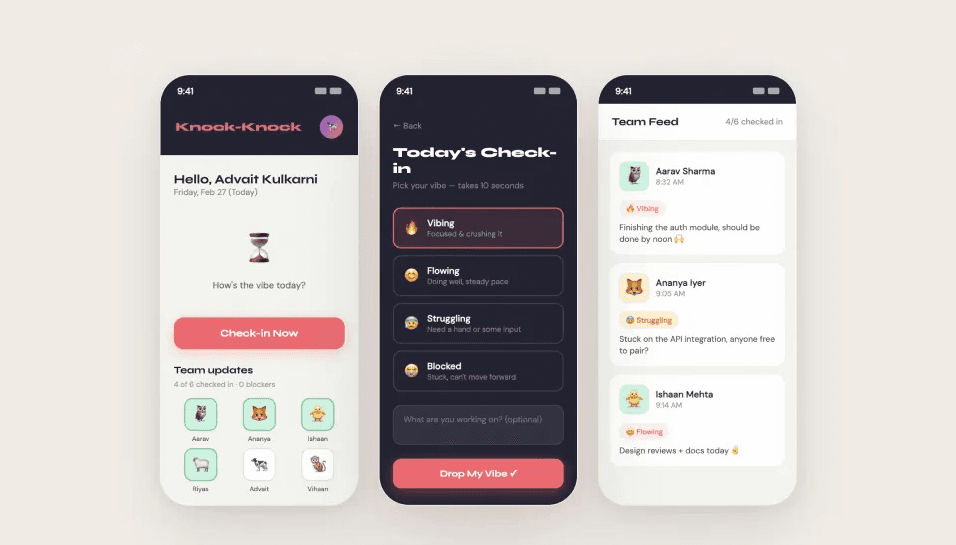
Knock-Knock: What’s the Team Vibe?

Most stand-ups solve a coordination problem by creating a time problem. Knock-Knock takes a different approach: replace the meeting with a 30-second team pulse.
It gives remote teams a quick way to share how they’re doing, what’s moving, and what needs attention, without interrupting focused work.
Knock-Knock: Your 30-second team pulse. No meetings required.

Knock-Knock: What’s the Team Vibe?